
 Electromagnetic Compatibility(EMC)
EMC Test Accessories
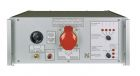
Schwarzbeck V-LISN CISPR16-1-2
The purpose of a LISN is to provide the device under test with energy, to carry the interference voltage to the EMI measurement receiver and to load the RF emitted by the device under test with standardized impedance.
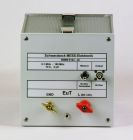
Schwarzbeck Automotive LISN
These LISNs are used for CISPR25, ISO 7637-2, BCI-Testing, DO160,and MIL standards.
High Voltage LISNs acc. to CISPR 25 Ed.4 are to measure the conducted disturbance voltage on shielded lines for (hybrid) electric vehicles (HEV, EV).
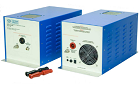
COM-POWER LISN
LISN stands for ‘Line Impedance Stabilization Network’. Com-Power offers a line of LISNs developed for conducted emission testing according to the most commonly adopted EMC specifications like CISPR, FCC, ISO, EN, RTCA DO-160 and MIL-STD 461.
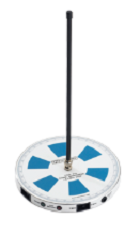
COM-POWER Comb Generator
As an EMC testing lab, the accuracy of your results is key to your reputation. Maintaining this accuracy requires properly calibrated quality equipment. Comb generators are an important piece of EMC radiated emissions testing equipment – one that can save you time and money by reducing your reliance on full, annual recalibrations of your site and instrumentation.
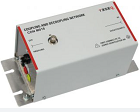
TESEQ CDN for IEC / EN 61000-4-6
IEC / EN 61000-4-6 specifies the design and performance of a range of coupling / decoupling networks (CDNs). Each CDN is specific to the type of cable and the intended signal carried on the cable.
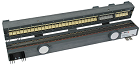
TESEQ EM Clamps
Annex A of IEC/EN 61000-4-6 gives additional information regarding the clamp injection. The KEMZ 801 is similar to the described EM clamp in the standard and injects the disturbance signal through a combination of inductive and capacitive coupling whilst decoupling the AE to values in excess of 10 dB above 10 MHz.
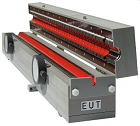
TESEQ Absorbing Clamps / Ferrite Tube
Absorbing Clamps are used for measuring interference signals on power supply cables. Decoupling clamps and ferrite tube are available for a variety of different EMC applications.
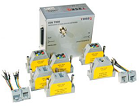
TESEQ Impedance Stabilization Networks (ISN)
Impedance stabilization networks (ISN, or with CISPR 16-1-2 called AAN: asymmetric artificial network) are defined for measuring of conducted common mode disturbances at information technology equipment (ITE) as required in CISPR 22 and CISPR 32.
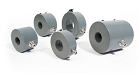
FCC Bulk Current Injection Probes
Fischer Custom Communications, Inc. develops and manufactures Bulk Current Injection Probes [BCI Probes] to meet specific customer requirements and to perform compliance testing in accordance with Mil-Std-461/462, RTCA/DO-160 Section 20 and 22, Bellcore TR-NWT- 001 089, SAE Jl5447, EN 55101-4 and CSEFA-2 EuroFighter and other susceptibility specifications.
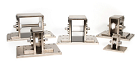
FCC Bulk Current Injection Probe Fixturea
Probe Calibration fixtures are a part of the test equipment required by most of the Bulk Current Injection [BCI] Test Procedure Specifications. These test fixtures allow the user to quickly and easily calibrate a Bulk Current Injection Probe prior to performing compliance testing.
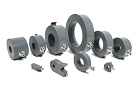
FCC Current Monitor Probes
The Current Monitoring probes may be used whenever RF current measurements are required. Current measurements are made by placing a current carrying conductor within the “sensing” window of the probe and measuring the probe’s output voltage with an RF detector.
FCC Current Monitor Probe Fixtures
Calibration fixtures are a part of the test equipment required by most of the Bulk Current Injection Test Procedure Specifications. This test fixture allows the user to quickly and easily calibrate the injection probe prior to performing the compliance testing.