
Monthly Archives: November 2020

TOYO Announces New Self-developed Vehicles and Components Emission Measurement Software ES10/VE


TOYO Announces New Self-developed Vehicles and Components Emission Measurement Software ES10/VE

New Support for CISPR25:2016 Annex I, HV/EV testing
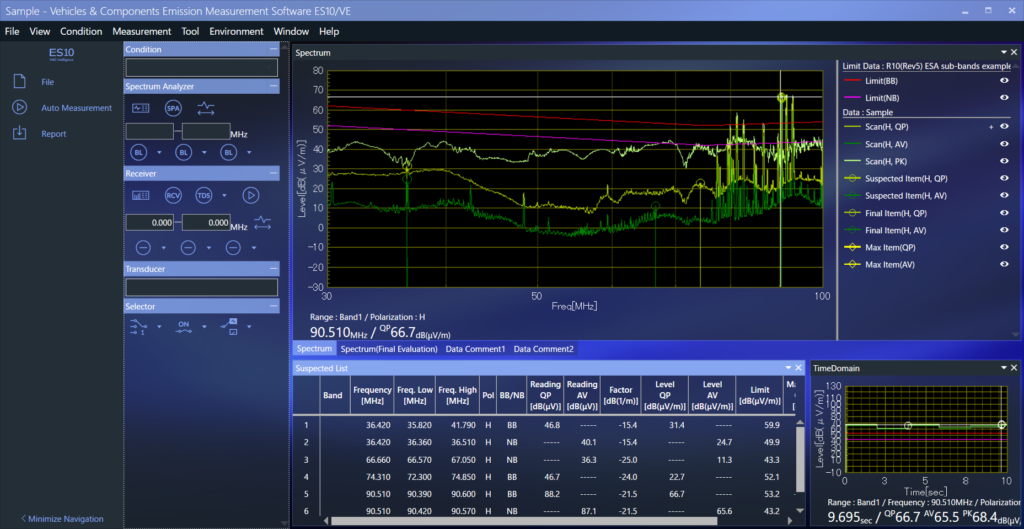
Fremont Calif., November 19, 2020 – TOYO Corporation (Tokyo Stock Exchange 1st Division, Code:8151) announces “ES10/VE”, a new software product for EMI*1 measurement of vehicles and on-vehicle components and EMI compliance evaluation*2. This software is an internally developed product of TOYO Corporation.


Product Summary

ES10/VE” is a new emission measurement software application developed by One Technologies Company, one of TOYO’s inhouse companies engaged in product development projects. This software is used together with an EMI receiver to measure the electromagnetic noise (emission) from automobiles and on-vehicle equipment. “ES10/VE” supports a variety of EMI receivers including those designed by Keysight Technologies and Rohde & Schwartz, which is one of the key advantages of this product.

“ES10/VE” supports “CISPR 25*3: 2016 Edition 4?Annex I,” an international EMI standard for automobiles. This annex has been added to define the evaluation method for power supply systems with high voltage components mounted on EV and HV since such systems using an increased amount of voltage could cause new noise interference.

Furthermore, two new features that help you to reduce the time to identify noise and take a countermeasure are implemented in “ES10/VE”. One is to show the measured electromagnetic noise in the time domain in addition to the frequency domain and the other one is to show a comparison between two sets of measurement data. You can visualize in the time domain view the timing of when the electromagnetic noise appeared and with this, you can easily pinpoint the noise source by finding a section of the noise that runs with the same timing. Also, with the spectrum graph comparison feature, the measurement results can be easily compared before and after a countermeasure is taken, which reduces the time to determine the right countermeasures.


EMI measurement software lineup 

TOYO’s self-developed EMI measurement software is now available in two series – the “ES10” series that supports a wide variety of EMI receivers and other EMI related test equipment (antenna mast, turntable, etc) and the “EPX” series*4, the high end series specifically developed for the most recent and top-of-the-line EMI receiver from Keysight Technologies. Using the unified platform (software’s base structure) for both series, we will minimize the functional differences and the time to release new features.


Key features – The latest features that have been implemented only in the “EPX” series are now available on the “ES10” series*6

  • Easily identify the recently-increasing complex noise of current vehicles using the “time domain scan” feature
  • Spectrum graph comparison feature that facilitates the comparison and analysis of multiple sets of measurement data
    Improved UI
  • Customizable UI that can be tailored to your workflow
  • Support of CISPR 25:2016 Edition 4 Annex I (Evaluation of power supply systems for high-voltage components to be used on EV/HV)
  • Unified platform with the high-end software series, “EPX”
  • With the unified platform introduced with “EPX,” the differences between models and series have been minimized or even eliminated, which allows for faster delivery of enhancements for both series
  • “EP9/VE” users can migrate their measurement conditions and other settings to ES10/VE*7.


About TOYOTech
TOYOTech LLC, founded in Fremont, California in 2015, is a wholly-owned local subsidiary of TOYO Corporation. TOYOTech provides the customers in the US and several other countries with TOYO Corporation’s self-developed products incorporating the know-how and technologies accumulated over many decades, as well as TOYOTech’s own-developed products that are unique in the markets – these include test and measurement solutions for automobile, new materials, Information and Communication Technologies (ICT), and EMC applications among others. At the same time, TOYOTech keeps a keen eye on the newly emerging technologies and up-to-date information in Silicon Valley, a holy site of innovation, actively collaborating with startups and seeking M&A opportunities. For more information, please visit the company’s website at https://www.toyotechus.com.

About TOYO Corporation
TOYO Corporation (TSE: 8151) is a Japanese technology company headquartered in Tokyo, Japan, with subsidiaries in the United States and China. Since its founding in 1953, TOYO has become the leading distributor of advanced measurement instruments and systems in Japan. TOYO also engages in original product designs and develops advanced solutions for many of markets that its serves including automotive, sustainable energy, and cyber security industries. TOYO’s innovative products are used by many leading companies in Japan, the United States and APAC countries, helping TOYO’s customers accelerate development, reduce time-to-market, and improve product quality. For more information, please visit the company’s website at https://www.toyo.co.jp/english.

Contact
Bo Han | TOYOTech
bo.han@toyotechus.com
www.toyotechus.com/auto
1-510-438-9548


*1 Electromagnetic Interference?
*2 Evaluation to determine whether the electromagnetic noise emitted from a product stays within the limits defined by each country, area, or product segment.
*3 One of the CISPR international standards that defines limits and procedures for the measurement of radio disturbances to protect on-vehicle receivers. The most recent edition, namely Edition 4, was officially published in 2016.
*4 A series comprised of “EPX/RE” for radiated emission, “EPX/CE” for conducted emission and “EPX/VE” for automotive and on-vehicle equipment
*5 A series comprised of “ES10/RE” for radiated emission, “EPX/CE” for conducted emission (to be released) and “ES10/VE” for automotive and on-vehicle equipment
*6 Some features of the “EPX/VE” such as “Accelerated Time Domain Scan feature” are not supported by the “ES10/VE”.
*7 This can be done only with support from TOYO’s technical support engineers.

TOYO Launches Target Simulator ASGARD2 with Support for Variable Field of View


TOYOTech Launched UniqueSec’s Radar Target Simulator ”ASGARD2” Supporting Variable Angle Perception in Japan

ASGARD2 is used for Evaluation of ADAS functions on mmWave radar sensors

Fremont Calif., November 5, 2020 – TOYO Corporation (Tokyo Stock Exchange 1st Division, Code:8151) launched the next generation of radar target simulator, “ASGARD2” developed by a Swedish company, UniqueSec AB on (enter the launch date). Supporting the variable angular perception of targets, the “ASGARD2” can be used for testing automotive millimeter wave (mmWave) radar sensors.


Product Overview

The radar sensing technology enables detection of other vehicles and obstacles (targets) and is critical for AEB (Automatic Emergency Brake) and other ADAS functions. The “ASGARD” series products simulate virtual targets for the mm-Wave radar sensors, one of the core sensors on the vehicles, and enable validation of the ADAS functions realized by the mm-Wave radar sensors while varying the viewing angle (direction in which the sensor receives radio waves). With the patented technology for signal processing in the frequency domain, the “ASGARD” series can run test scenarios to simulate such as near collision, thanks to one of its key features that enables generation of simulated targets at almost 0 meters distance from the radar sensor under test. In addition, simultaneous simulation of multiple angles of arrival from multiple targets without mechanical movement of ASGARD antennas (the gold chassis in the above photo) or the radar under test is implemented in the “ASGARD2”. This is the industry’s first product2 developed based on MIMO technology.

Interfaced to the vehicle dynamics and traffic simulation software, the “ASGARD2” can be used to build a HILS (Hardware in the Loop Simulation) system for the mm-Wave radar sensor under test, which allows you to test the collision avoidance function and all other ADAS functions indoors.


Product Details

The mm-Wave radar sensor’s functions are currently tested both in the test field and in HILS setups using a target simulator. In field tests, targets such as surrounding vehicles, pedestrians and bicycles are actually set up. When the test scenarios get complicated, however, the locations and number of targets need to be changed repeatedly, which entails cost and time. The HILS systems can cover this shortcoming; However, the distance from the vehicle under test to the target could not be reduced to less than a few meters due to the system performance including the delay caused by the target simulator’s signal processing and circuit length. Thus, it was not possible to test the collision avoidance function of AEB as test scenarios including a situation just before a collision where the distance to the target is less than a few meters could not be simulated.
With patented technology in “ASGARD2” for target generation in the spectrum domain, you can now set the distance between the radar under test and simulated targets to almost 0 (zero) meters, which enables you to test the collision avoidance functions. Similarly, when the angle of arrival from the target needs to be added to the simulation, it took more time for the test since the test antenna of the target simulator needed to be mounted on a rail or dolly. It was therefore not easy to run test scenarios including cut-ins and rush-outs. Taking the advantage of the MIMO technology for electronic generation of angles in “ASGARD2”, test scenarios mentioned above can be run without moving the antennas.

The “ASGARD2” can evaluate the processing algorithm of the mm-Wave radar sensor, helping you efficiently simulate the angle of arrival, relative speed and distance of the approaching target in order to test the collision avoidance function of the vehicle that uses the sensor under test. Different mm-Wave radar sensor functions can be evaluated by “ASGARD2” thanks to the control software which allows to set various targets with variable angle of arrival, distance, and relative speed. Another key feature of “ASGARD2” is its compact design – such that it can be placed on a desk in the office for operation. Being used indoors or in a controlled environment, “ASGARD2” enables highly repeatable tests.


Key features 

??Simulated distance to target: almost 0 to 300 meters (with the use of patented signal processing technology)
??Simulation of angles of arrival from multiple targets without moving the test radar (with MIMO technology)
??Separate system configuration: Unit and antenna module allow for flexible setup
??Simultaneous simulation of 200 plus targets


About UniqueSec AB
Established in 2013, UniqueSec AB is a manufacturer specializing in short-range, high-frequency, and wideband radar signal processing. UniqueSec AB has developed state-of-the-art signal processing algorithms for level measurements, distance and speed measurements, presence detection, external monitoring, and object classification, and has obtained patents in many countries and regions.  This algorithm has been developed to design radar testing and evaluation solutions for use in various applications including automobiles. UniqueSec AB provides products that are useful for evaluating the safety and reliability of Advanced Driver-Assistance Systems and autonomous driving.  For more information, please visit the company’s website at https://www.uniquesec.com/.


About TOYOTech
TOYOTech LLC, founded in Fremont, California in 2015, is a wholly-owned local subsidiary of TOYO Corporation. TOYOTech provides the customers in the US and several other countries with TOYO Corporation’s self-developed products incorporating the know-how and technologies accumulated over many decades, as well as TOYOTech’s own-developed products that are unique in the markets – these include test and measurement solutions for automobile, new materials, Information and Communication Technologies (ICT), and EMC applications among others. At the same time, TOYOTech keeps a keen eye on the newly emerging technologies and up-to-date information in Silicon Valley, a holy site of innovation, actively collaborating with startups and seeking M&A opportunities. For more information, please visit the company’s website at https://www.toyotechus.com.

About TOYO Corporation
TOYO Corporation (TSE: 8151) is a Japanese technology company headquartered in Tokyo, Japan, with subsidiaries in the United States and China. Since its founding in 1953, TOYO has become the leading distributor of advanced measurement instruments and systems in Japan. TOYO also engages in original product designs and develops advanced solutions for many of markets that its serves including automotive, sustainable energy, and cyber security industries. TOYO’s innovative products are used by many leading companies in Japan, the United States and APAC countries, helping TOYO’s customers accelerate development, reduce time-to-market, and improve product quality. For more information, please visit the company’s website at https://www.toyo.co.jp/english.

Contact
Bo Han | TOYOTech
bo.han@toyotechus.com
www.toyotechus.com/auto
1-510-438-9548

First Image: The FMCW (Frequency Modulated Continuous Wave) radar can express the delay in radio wave with the frequency shift. This technology calculates the changes in the reflection signal element (reflection from a target) by mathematical processing using the changes in frequency instead of using a delay-line that changes the delay in the time domain.
Second Image: HILS system configuration : As of October 2020, researched by TOYO Corporation
*3 A development tool that simulates the vehicle behavior on the software.