Category Archives: AUTO News & Events

Automotive Measurement Testing

News Flash: TOYO and Iwane Unveil Augmented Reality Feature for the Real Video Drive Player

TOYO and Iwane Unveil Augmented Reality Feature for the Real Video Drive Player

New Capability Provides a More Realistic Driving Simulation Environment
and Supports the Development Efforts of Advanced Driver Assistance Systems, Electric Cars, and Autonomous Vehicles


Tokyo, Japan, August 24, 2021 – TOYO Corporation has added an augmented reality (AR) feature to the Real Video Drive Player (RVDP), a driving simulator co-developed with Iwane Laboratories. The RVDP software enables virtual driving, using real previously recorded footage. AR is a technology that is employed to insert digital objects into RVDP. The enhanced RVDP also supports multiple drivers operating in the same simulation space. With these new capabilities, the RVDP continues to provide enhanced test and simulation scenarios beyond what is currently commercially available.
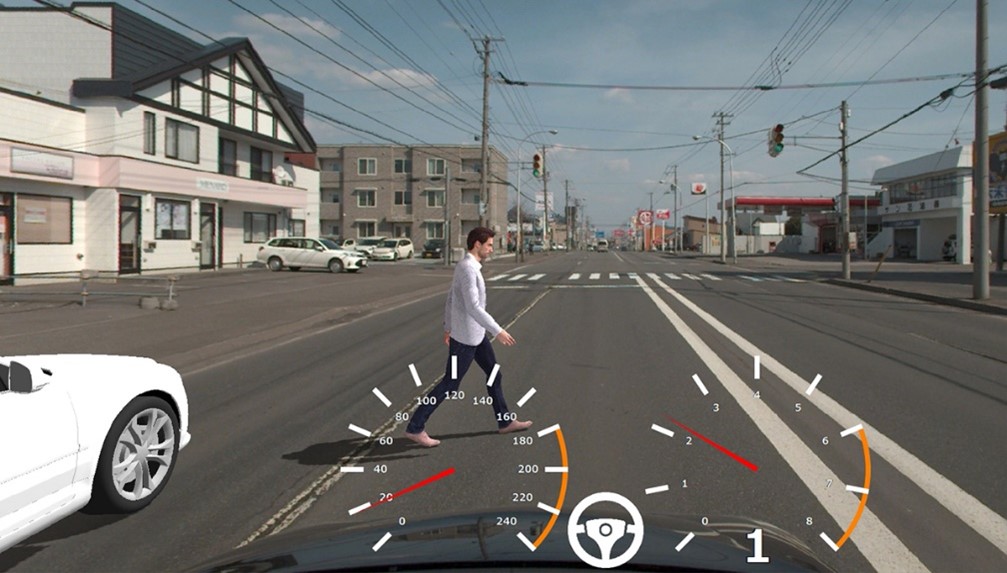
AR allows for the addition of a digital pedestrian into a street video scene previously recorded


In driving simulations, the presentation of virtual environments that are an accurate representation of real-world environments is ideal when performing vehicle design and testing. This is true with all vehicles, including electric vehicles (EV), ADAS (Advanced Driver Assistance System), and autonomous vehicles. Driving simulators also need to support the concepts of immersion and realism as they aid engineers to evaluate and tune the vehicle design. Many driving simulation spaces are built and altered using Computer Graphics (CG). Because of the processing requirements, these tasks, whether the creation of a new space or modification of an existing one, can be resource and time-intensive, slowing down design and development cycles.
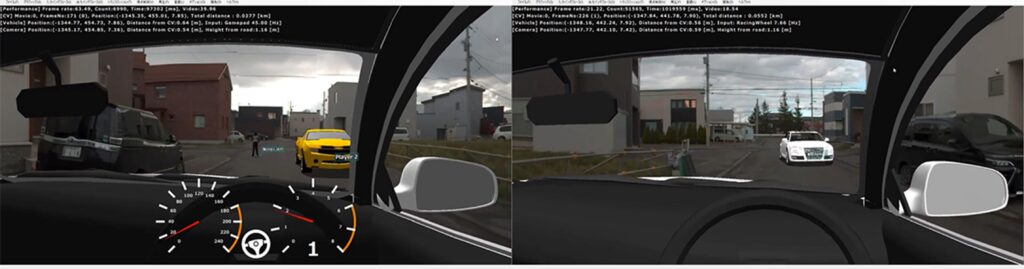
 

Multiple drivers can co-exist in the same simulation space.
(The left image is the view from the driver in the white car, the right image is the view seen from the driver in the yellow car)


The Real Video Drive Player is a driving simulator that uses real video footage that was previously shot and recorded with a specialized 360° camera. Vehicle speed and steering angle information are synchronized and saved with the video. Since actual videos and images are used instead of CG, engineers can evaluate and adjust vehicle design behavior with a high degree of immersion. In addition, simulation spaces are created using previously recorded footage and after several days of processing, it is ready to be used. The RVDP integrates with vehicle motion simulators such as CarSim and CarMaker. CarSim is developed by Mechanical Simulation of the United States, while CarMaker is developed by IPG Automotive of Germany. Both simulate the performance of passenger vehicles and light-duty trucks.

The RVDP that was first released in November 2018 only utilized static footage, so test scenarios were not extendable like with CG. With the new release, the RVDP allows multiple drivers to co-exist in the same simulation space. Drive engineers can maneuver a vehicle near another one that is under test. They can also create scenarios such as passing a vehicle or responding to a vehicle ahead that is suddenly engaging its brakes without the need for programming.

The RVDP’s AR feature allows the insertion of digital moving objects such as vehicles and pedestrians into the previously recorded video footage. For example, engineers can design scenarios where a pedestrian runs out into an intersection or a vehicle suddenly cuts into a lane. Engineers can develop, insert and control 3D models using standard modeling software. The enhanced version RVDP also supports the verification tests of EuroNCAP and ADAS. EuroNCAP (European New Car Assessment Programme) is a car safety performance assessment in Europe.

The key features of the Real Video Drive Player include:
・ Utilizes real video footages
・ Incorporates anti-shake camera technology
・ Synchronizes video footages with vehicle speed
・ Changes the viewpoint of drivers
・ Reproduces vehicle movement and view changes along with steering wheel operation
・ Reproduces different paths caused by lane changes or other vehicle movements
・ Integrates with advanced vehicle modeling software
・ Links with advanced GPS (GNSS)
・ Supports multiple drivers in the same simulation space
・ Deploy any 3D objects

The new RVDP is now shipping. Please contact TOYO or your sales representative if you would like to see a demo or if you need more information.


About Iwane Laboratories, Ltd.

Since its foundation in 1979, Iwane has kept developing the latest image processing technology with the concept “We realize we are loved by the earth, and we love the earth.”  Especially, its 3D GIS (Geographic Information System) is widely used in the field of road traffic such as geography and road surface and gains an excellent reputation globally. The patented CV (camera vector) technology, which converts 2D Spherical video into 3D supports the system and enables the acquisition of 3D road information in a short time for the first time in the world. For more information, please visit the company’s website at  www.iwane.com/eng.


About TOYO Corporation’s Automotive Business

Focusing on advanced automotive technological areas, TOYO has been strengthening its sales force and sharing its technical know-how among various teams since 2018.  There have been growing needs for EMC testing in the automotive space with the increased use of electronics in automobiles and the active development of ADAS and autonomous driving technologies. With 40 plus years of experience in EMC testing, a large number of installations for manufacturers and EMC test service providers, and consultation by our EMC engineers, many of which are iNARTE-certified, TOYO will continue to propose its own EMC test system for in-vehicle equipment that best suits the customer’s needs and contribute to the improvement of car safety.  iNARTE-certified is a global technical certification created by iNARTE (The International Association for Radio, Telecommunications, and Electromagnetics), a US non-profit organization, to recognize the skills of EMC engineers.  For more information, please visit the company’s US website at www.toyotechus.com.


Contact
info@toyotechus.com


All trademarks used in this document are the property of their respective owners. TOYO reserves the right to change product content and product specifications without prior notice. Contact your sales consultant for the latest information.
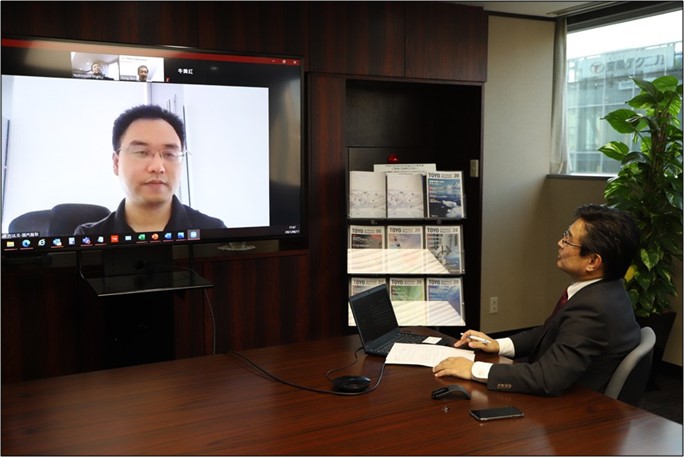
TOYO Technical Magazine Interview: Measurement Technologies Help Shape the Mobility Society of Tomorrow

We spoke with Mr. Fang Dalong, a Senior Manager of the Platform Division at the “China Intelligent and Connected Vehicles (Beijing) Research Institute” (CICV), and asked him to provide us with an update on ADAS and AD technologies in China. We also talk to him at length about CICV’s decision to create OTA-testing facilities, and how they see their role as test pioneers in the industry.  CICV is China’s national research institute.  This is a fascinating interview providing deep insights into the intelligent connected vehicle market in China and likely the rest of the world.  Click here to read the entire interview.

TOYO Engineers In-Vehicle Equipment Immunity Test System for the Japan Quality Assurance Organization

TOYO Engineers In-Vehicle Equipment Immunity Test System for the Japan Quality Assurance Organization

Leading Measurement Company Supports the Diverse Requirements of Electric and Hybrid Electric Vehicles Design and Test


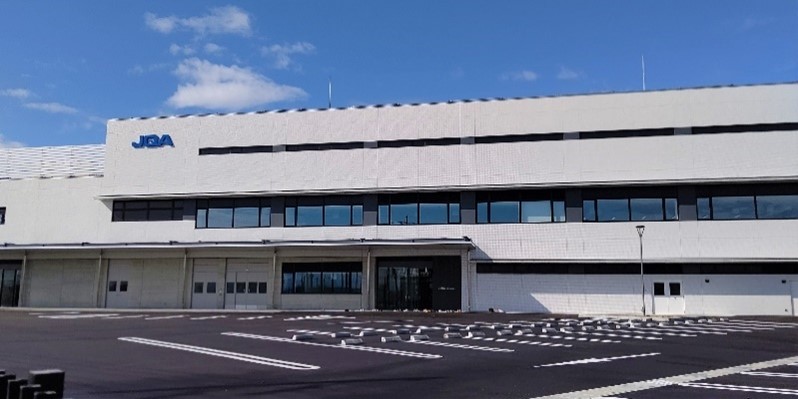
Tokyo, Japan, August 15, 2021 – TOYO Corporation (Tokyo Stock Exchange 1st Division, Code: 8151), the parent company of TOYOTech, delivered a TOYO-developed immunity test system for in-vehicle equipment to the Japan Quality Assurance Organization (JQA), a non-profit certification entity.  The JQA is headquartered in Tokyo and is led by its president Noriaki Kobayashi.  This system will be deployed in the first reverberation chamber ever installed in the Central Japan (Chubu) area.


With the rapid shift to Electric and Hybrid Electric Vehicles, the development of Advanced Driver Assistance Systems (ADAS), and the development of automotive technologies in a new technology area known as “CASE (Connected, Autonomous/Automated, Shared),” the test and evaluation requirements and needs for in-vehicle equipment are becoming more diverse.  To respond to such needs, the JQA has launched extensive EMC test services to support the automotive industry by building and deploying a state-of-the-art automotive EMC laboratory network that connects laboratories in Tokyo, Osaka, and Nagoya.  The first anechoic chamber was constructed in Osaka in November 2019.  The JQA then built two additional anechoic chambers in Tokyo in January 2021 and three chambers in the Chubu Test Center in May 2021.  All these chambers are designed specifically for performing in-vehicle equipment tests.


And now with TOYO’s help, the JQA recently rolled out the first reverberation chamber in the Central Japan area to provide EMC test services.  To leverage the full potential of the chamber, the JQA has selected TOYO’s immunity test system for in-vehicle equipment.  This enables the Chubu Test Center to support the widest range of testing and evaluation needs for in-vehicle equipment.

The JQA considered many factors during the vendor selection process.  Ultimately TOYO’s shipment record, its ability to provide support on the system during initial integration and future expansion, the performance, and functions of the system, and the flexibility and power of TOYO’s EMC software were what led the JQA to select TOYO.

Used for the same purpose as the immunity test in which noise is directly applied to a DUT using an antenna, a reverberation chamber employs a completely different method.  Statistically isotropic and electrically homogeneous RF field conditions are created by changing the propagation of RF output from the antenna in the shield room using the reflection on the internal shield surface and the movement of the stirrer inside.  The technique has been acknowledged to accurately simulate a driving environment with a high degree of noise generated by autonomous driving and connected cars.

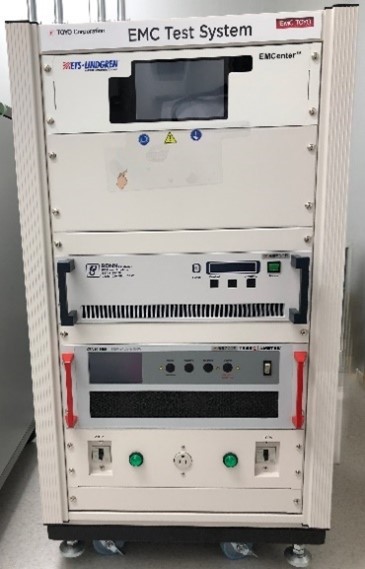
The immunity test system for in-vehicle equipment is the system used to test in-vehicle electronic equipment while it is exposed to electromagnetic noise.  It supports a variety of standards, ranging from international standards to automotive manufacturers’ own standards.  The system covers a wide range of immunity testing that is required by in-vehicle equipment.  The system is managed by TOYO’s EMC software with components for radiated immunity test (“VI5/RS”), conducted immunity test (“IM5/CS”), radiated and conducted emission measurement (“ES10/VE”), and reverberation chamber test (“IM5/Rrvc”) pre-installed.  The system also features a power amplifier that generates highly efficient output.

We are honored to have been selected by the JQA and we look forward to continuing to help shape next-generation automobile design and test.


About TOYO Corporation’s Automotive Business

Focusing on advanced automotive technological areas, TOYO has been strengthening its sales force and sharing its technical know-how among various teams since 2018.

There have been growing needs for EMC testing in the automotive space with the increased use of electronics in automobiles and the active development of ADAS and autonomous driving technologies. With 40 plus years of experience in EMC testing, a large number of installations for manufacturers and EMC test service providers, and consultation by our EMC engineers, many of which are iNARTE-certified, TOYO will continue to propose its own EMC test system for in-vehicle equipment that best suits the customer’s needs and contribute to the improvement of car safety.  iNARTE-certified is a global technical certification created by iNARTE (The International Association for Radio, Telecommunications, and Electromagnetics), a US non-profit organization, to recognize the skills of EMC engineers.


About Japan Quality Assurance Organization

The Japan Quality Assurance Organization (JQA) is a not-for-profit organization specializing in registration services for ISO management systems as well as safety testing and certification for compliance to a variety of standards, both national and international. We started our operation in 1957, initially as a designated inspection body under Japan’s Export Inspection Law. Our work contributed to the postwar recovery of and an export-oriented Japanese economy by testing and certifying products destined for overseas markets.

Built on rich expertise and know-how in testing and certification, we have continuously added to our conformity assessment services, while being accredited by relevant authorities both at home and abroad, so as to meet the varied need that developed with the globalization of the economy.

Today, more than half the JQA staff engage in registration services for ISO management system standards. Besides, we deliver services ranging from product and component safety, to the health and safety of the public, to environmental evaluations, to the authentification of compliance to regulations for fast-growing information technologies.

Quality assurance and conformity assessment by an impartial third-party organization play an important role in facilitating business transactions across borders. We have been strengthening our global network of services through contracted partnerships with overseas providers of testing and certification services. Through such networks, JQA promotes cost-effective one-stop-shopping services for multiple access to safety/certification marks in major countries.

Since its founding, JQA has held a high reputation as a forerunner of conformity assessment services. Our commitment to meet the satisfaction of business, industry, government, and consumers will become even more solid well into the new century.  https://www.jqa.jp/english/


Contact
info@toyotechus.com


Collateral Alert: RayRobo Series Product Brochure

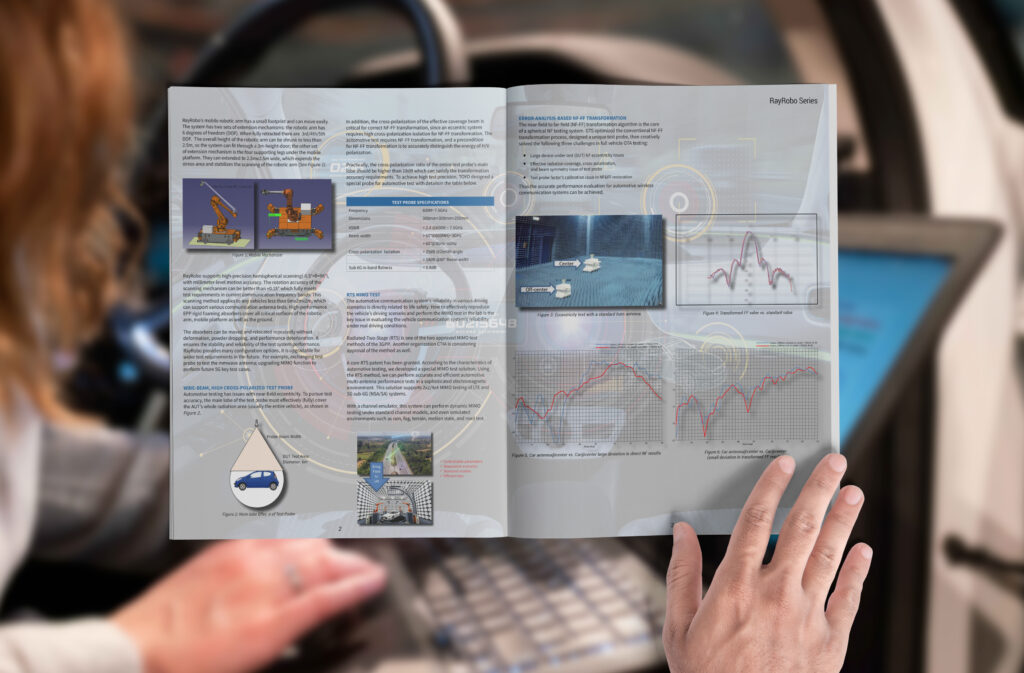
The automotive industry is undergoing a profound change with Intelligent Connected Vehicles (ICVs) being widely viewed as the future of mobility.  With the convergence of vehicle information communication, AI, the internet, and other technologies, the ICV enters a new stage of rapid technology evolution with a variety of communication devices (including wireless transceiver, antenna, and corresponding software).

Continue reading …

TOYO Awarded Key Solid-State Battery Technology Patent in China

TOYO Awarded Key Solid-State Battery Technology Patent in China

Innovative Probe Technology with High-Frequency Impedance Measurement System Supports and Advances Research and Development of Solid-State Batteries

Tokyo, Japan, June 24, 2021 – TOYO Corporation is pleased to announce that the company was awarded a key patent in China in April 2021 for probe technology installed in the solid-state battery electrolyte evaluation solution “High-Frequency Impedance Measurement System.”  The Chinese patent number assigned is CN 111226120 B and named “Explorer.”  This patent demonstrates our commitment to contribute and advance the development of high-frequency impedance measurement systems in China and to take advantage of the favorable market trends for the use of this technology.  TOYO has already secured a similar patent (No. 6324648) for the technology called “Probe” in Japan in April 2018.

Currently, environmental efforts are being made globally to realize a carbon-neutral (“decarbonized”) world.  The introduction of electric vehicles (EV) is but one more step society is taking to reducing greenhouse gas emissions that cause global warming.  However, with the introduction of EVs, issues such as the energy capacity, safety, and length of charging time of the onboard storage batteries have been raised. Solid-state batteries are believed to be key technologies that ameliorate these challenges and are being heavily researched for deployment throughout the world.  Japan is one of the first countries to embark on this research, but China also has poured resources into this area.  Market trends predict by 2035, EVs will account for 50% of all new vehicle sales in China.

The “High-Frequency Impedance Measurement System” is a device that evaluates the performance of solid electrolytes, which are components of all-solid-state batteries.  To characterize the ionic conductivity of a solid electrolyte, the reaction resistance of the solid electrolyte in the grains, grain boundaries, and electrode interface must be accurately evaluated and measured.  To accomplish this, it is necessary to apply a high frequency and to change the temperature environment of the sample for measurement.  TOYO has developed a unique probe structure to measure impedance at a high frequency of 100MHz.  Further, we have achieved control over a wide temperature range, from -183°C to 200°C.

This technology is an enabling one.  With it, it is possible to capture phenomenon unique to solid electrolytes that normally are not observable.  This is a key characteristic that is indispensable for conducting research and development of this class of all-solid-state batteries.

Product page: https://www.toyo.co.jp/material/products/detail/4990EDMS_120K


About TOYO Corporation
Since its founding in 1953, Toyo Corporation has been importing and selling the world’s most advanced measuring instruments. Current business fields include information and communications, automobiles, energy, EMC (electromagnetic compatibility), marine, software development, life sciences, etc.

We are expanding our business both domestically and internationally by focusing on the development of our products designed with our measurement technologies.

Under the slogan of “Creating the future with “Hakaru measuring technology”, the spread of 5G (5th generation mobile communication system) and the development of self-driving cars

By providing the latest solutions that support the future of technology, we contribute to the creation of a safe and environmentally friendly society, and the development of industry.  Please visit the company’s website at https://www.toyo.co.jp/english.


Contact
info@toyotechus.com


Collateral Alert: RayBow Series Product Brochure

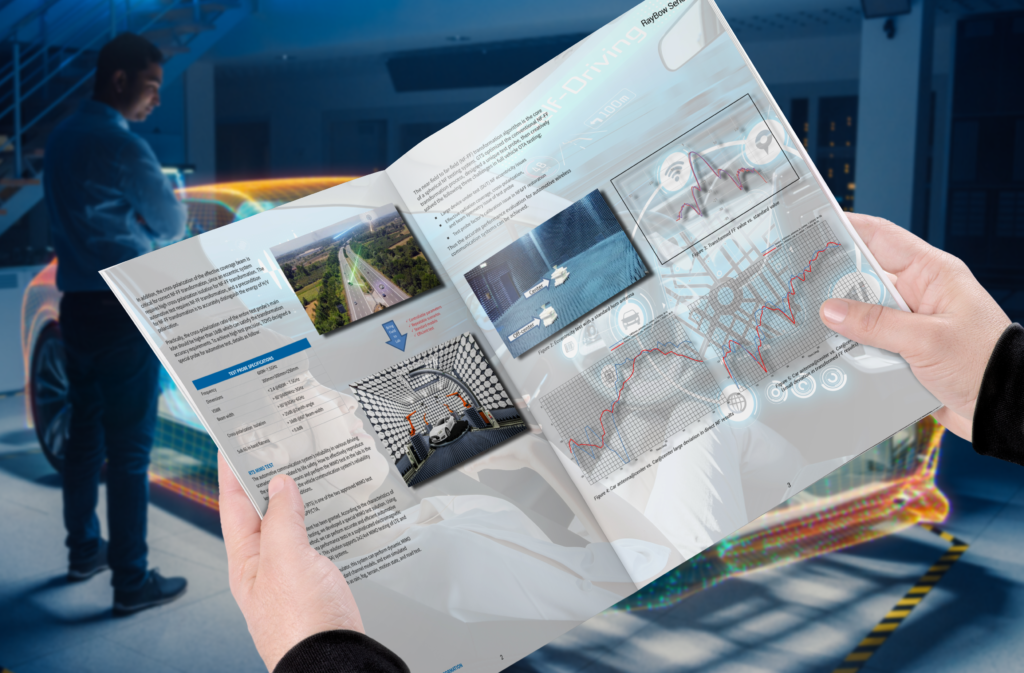
An intelligent connected vehicle (ICV) is fitted with a myriad of wireless systems (V2X, cellular, Bluetooth, satellite navigation, etc.). To ensure the reliability and integrity of vehicle operation, we must perform full vehicle communication performance testing in a real environment. The two major challenges of the test are how to perform a near field antenna and EIRP/EIS test under the eccentric condition, and how to rebuild a real-world transmission environment in the lab and execute the MIMO performance test.

Continue reading …

TOYO Wins Large Contract with Major Institute Focused on Intelligent Connected Vehicle Research

TOYO Wins Large Contract with Major Institute Focused on Intelligent Connected Vehicle Research

To Deliver Innovative Wireless Communication Performance Measurement System for Connected Vehicles in a Deal Worth 5 Million USD

Tokyo, Japan, May 12, 2021 – TOYO Corporation announces that its Chinese subsidiary, TOYO China, received an order for a “Wireless Communication Performance Measurement System for Connected Vehicle” from the China Intelligent and Connected Vehicles (CICV) Research Institute in Beijing. The order amount is 5 million USD, with a scheduled delivery targeted for June 2022.

This system applies the Radiated Two-Stage (RTS) method approved under 3GPP as a test method for LTE mobile terminals and base stations to measure the in-vehicle wireless communication performance required for connected vehicles.  Since its founding in December 1998, the 3GPP or Third Generation Partnership Project has been a collaboration established to develop protocols and globally agreed specifications for third-generation (3G) mobile systems.

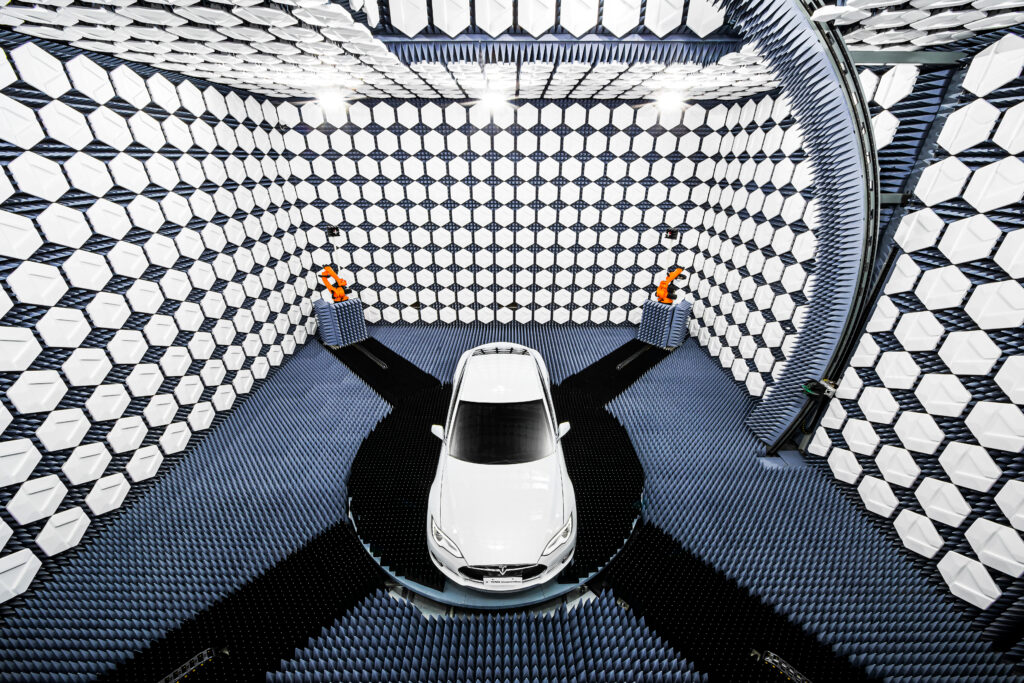
The TOYO Wireless Communication Performance Measurement System can be augmented to support a large-scale Electro Magnetic Compatibility (EMC) anechoic chamber for automobiles.  EMC refers to a device that is compatible with its electromagnetic environment and it does not emit levels of EM energy that cause electromagnetic interference in other devices in the vicinity.  As a result, the TOYO Wireless Communication Performance Measurement System can support Over-The-Air (OTA) test needs in conjunction with existing EMC testing systems for in-vehicle wireless communication performance evaluation essential for the development of connected vehicles.  Over-The-Air testing is a technique used to evaluate performance in a wireless communication environment.

Through a strategic partnership with CICV, a national research institute with advanced technology that leads the ICV (Intelligent Connected Vehicle) industry in China with global influence, TOYO Corporation continues to expand its business footprint not only to China, but also to the United States, and other overseas markets taking advantage of its broad EMC business field experience.

TOYO Corporation supports the development of safer vehicles by providing measurement solutions necessary for the development of advanced driver assistance systems (ADAS) and autonomous driving (AD), for both domestic and overseas markets.


New performance measurement systems required for development of highly reliable connected vehicles
As the level of autonomous driving progresses, the importance of Vehicle to Everything (V2X) to measure the wireless communication performance of vehicles by OTA is increasing to realize highly reliable advanced driver assistance systems (ADAS) and autonomous driving (AD). Vehicle to Everything is a technology that allows vehicles to communicate with moving parts of the traffic system around them or with one another.  In China, there is a movement to require these evaluations as certification tests for vehicle sales, and each national laboratory is considering the introduction of a new measurement system that corresponds to these new technologies. In addition, China is promoting the adoption of cellular V2X as the main communication technology used in connected vehicles. As 5G cellular communication technology becomes popular in mobile networks, V2X, which includes 5G as one of its communication modes, is expected to become the mainstream technology of intelligent network vehicles and standard for the autonomous driving market. Conventional OTA measurement systems have limited performance in evaluating automotive vehicle systems and have not been able to meet the measurement requirements for connected car development through wireless communication.


Enabling measurement of in-vehicle wireless communication performance essential for the development of connected vehicles 
The “Wireless Communication Performance Measurement System for Connected Vehicles” is a system for measuring the wireless communication performance of automobiles. It was developed by General Test Systems, one of the industry’s leading companies in the field of mobile terminals, antennas, and OTA testing. This system utilizes GTS’ Radiated Two-Stage (RTS) method patented technology and the technology has been approved by the 3GPP as a test method for LTE mobile terminals and base stations for the measurement of in-vehicle wireless communication performance for connected vehicles.  Radiation performance, reception sensitivity, electromagnetic interference, multi-antenna performance evaluation, and vehicle communication performance in real-world environments are also available for evaluation.


Proposing TOYO’s new total solutions utilizing our global knowledge and experience with EMC business successes
The wireless communication performance evaluation for automobiles can be customized to accommodate existing EMC test facilities. To meet test and measurement requirements for wireless communication quality for evolving connected car development, we develop new total solutions that combine our EMC testing and wireless communication evaluation experience and leveraging TOYO Corporation’s more than 40 years of EMC experience in Japan.


Key Features

  • GTS patented technology using the RTS method approved by 3GPP
  • 3D MIMO test is also possible for larger test devices and objects such as automobiles.  MIMO or Multiple Input Multiple Output is a wireless communication technology that transmits and receives data using multiple antennas at the same time
  • Lower capital expenditure costs than conventional multi-probe test systems
  • Large EMC anechoic chamber for automobiles can be scaled
  • Supports multiple testing needs, such as radiation performance, reception sensitivity, electromagnetic interference, multi-antenna performance evaluation, and evaluation of vehicle communication performance in real environments


About CICV
China Intelligent and Connected Vehicles Research Institute Co., Ltd. (CICV) was established in March 2019 by three leading automotive organizations in China: China Society of Automotive Engineers (SAE), China Association of Automobile Manufacturers (CAAM), and China Industry Innovation Alliance for the Intelligent and Connected Vehicles (CAICV). Domestic and overseas OEMs, in-vehicle equipment manufacturers, and the telecommunications industry are shareholders and operators. On March 30, 2019, the CICV was approved by China’s Ministry of Industry and Information Technology (MIIT) to strengthen global competitiveness and build a world-class platform to lead China’s Intelligent Connected Vehicle (ICV) industry and improve its position in the global value chain. http://www.china-icv.cn/en/


About TOYO China  
Established in 2010. Based in Shanghai and Beijing, we provide our customers with in-house developed EMC, fuel cells, batteries, liquid crystals, and information and communication systems utilizing our long-accumulated knowledge and technical capabilities.   https://www.toyochina.com.cn/


About TOYO Corporation
TOYO Corporation (TSE: 8151) is a Japanese technology company headquartered in Tokyo, Japan, with subsidiaries in the United States and China. Since its founding in 1953, TOYO has become the leading distributor of advanced measurement instruments and systems in Japan. TOYO also engages in original product designs and develops advanced solutions for many of the markets that it serves, including automotive, sustainable energy, and cybersecurity industries. TOYO’s innovative products are used by many leading companies in Japan, the United States, and APAC countries, helping TOYO’s customers accelerate development, reduce time-to-market, and improve product quality. For more information, please visit the company’s website at https://www.toyo.co.jp/english.


Contact
info@toyotechus.com